Glossary of Terms
Abaft – A location toward the stern of the vessel. Sometimes with reference to another point, as abaft the beam.
Anchors – Endeavour had two bow anchors (best bower and small bower), a sheet anchor, two stream anchors, and one kedge anchor.
Bower anchors were the two main anchors of the ship. The small bower weighed 17cwt 3qr 14lbs. The best bower weighed much the same. The bower anchors were carried permanently attached to their cables on each side of the bow, always ready to be let go in case of an emergency.
The sheet anchor, another large anchor of similar weight to the bower anchors, was stowed on the starboard abaft the best bower, to back up the other anchors if needed. As well as these three main anchors, there were two spares in the hold.
A stream anchor is a light anchor for use in narrow waterways. A kedge anchor is also a light anchor but lighter than the stream anchor. Both the stream and kedge anchors could be used as “coasting” anchors, for anchoring the ship in light condition, to save the heavy work of weighing the bower anchors. Otherwise, they were normally used to carry out astern when the bower anchor was down, with a hawser (a strong thick rope) to prevent the ship swinging. They were commonly used when warping the ship, being placed ahead of the ship on which she could haul herself. [We are indebted to Ray Parkin for this information.]
Arrack – A name in the East Indies and the Indian islands for all ardent spirits. Arrack is often distilled from a fermented mixture of rice, molasses, and palm wine of the cocoanut tree or the date palm.
Auger – A hand tool, typically having a threaded shank and cross handle, used for boring holes in wood.
Ball – A lethal charge of a single lead ball fired from a musket.
Ballast – Heavy material that is placed in a position low in the hull to provide stability.
Beam – The breadth of the ship at the widest point.
Bear away – To turn or steer a vessel away from the wind.
Bent – The sails were attached, or “bent,” to long horizontal spars of wood called “yards” suspended above the deck through a complex system of ropes.
Berth – A sleeping space on a ship. Also, the space allotted to a vessel at anchor or at a wharf.
Bilge – The compartment at the very bottom of the ship’s hull where water collects and must be pumped out of the vessel.
Blacklist – A list of people that are to be punished.
Block – A pulley with one or more sheaves or grooves over which a line is roved. It can be used to change the direction of the line, or in pairs used to form a lifting tackle.
Boat hook – A pole with a blunt tip and a hook on the end. Typically used to assist in docking and undocking a boat, with its hook used to pull a boat towards a dock and the blunt end to push it away from a dock, as well as to reach into the water to help people catch buoys or other floating objects or to reach people in the water.
Boatswain – A non-commissioned officer usually referred to as Bosun, who had responsibility for rigging, cables, anchors, sails and boats, who issues “piped” commands to seamen. The sailmaker and boatswain’s mates were under the command of the boatswain.
Booms – Masts or yards, lying on board in reserve.
Bow – The forward part of the hull of a ship.
Brig – A vessel with two square-rigged masts.
Bring to – To cause the ship to be stationary by arranging the sails.
Broadside – One side of the vessel.
Broiling – Cooking by exposing food to direct radiant heat from the fire.
Buoy – A floating conical cask used to show where the anchor lies.
Butt – Cask.
Cable – An especially large or thick rope. For the two bower anchors and sheet anchor Endeavour was supplied with seven cables, each 13½ inches in circumference by 120 fathoms (220 metres.) Each weighed 2 tons 5cwt 2 qr. and had a breaking strain of around 55 ½ tons. For the kedge and stream anchors, which were smaller, there were 5 and 6 inch hawsers (small cables). [We are indebted to Ray Parkin for this information.]
Cag – A small cask or barrel.
Careen – To incline the ship on one side so that her bottom on the other side may be examined.
Cask – A barrel.
Caulking – Oakum or other fibres driven into planking seams to make them watertight.
Chains – Platforms projecting from each side of the hull to increase the width where shrouds join the chain plates. This is where the Leadsmen stood, swinging the lead to take soundings.
Chart – A map showing coastlines, water depths, or other information of use to navigators.
Civil time – The new day begins at midnight.
Cockswain -The helmsman or crew member in command of a boat.
Collier – A collier is a bulk cargo ship designed or used to carry coal.
Compass –
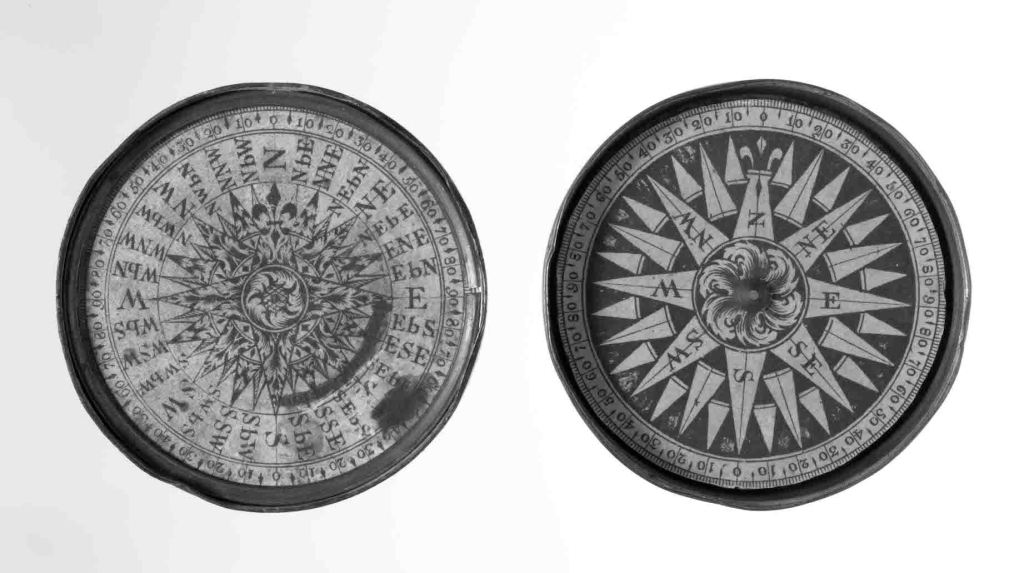
Compass abbreviations -NBE (North by East) NWBW (Northwest by West) etc.
Consumption – Tuberculosis.
Course – The point of a compass to which the ship steers.
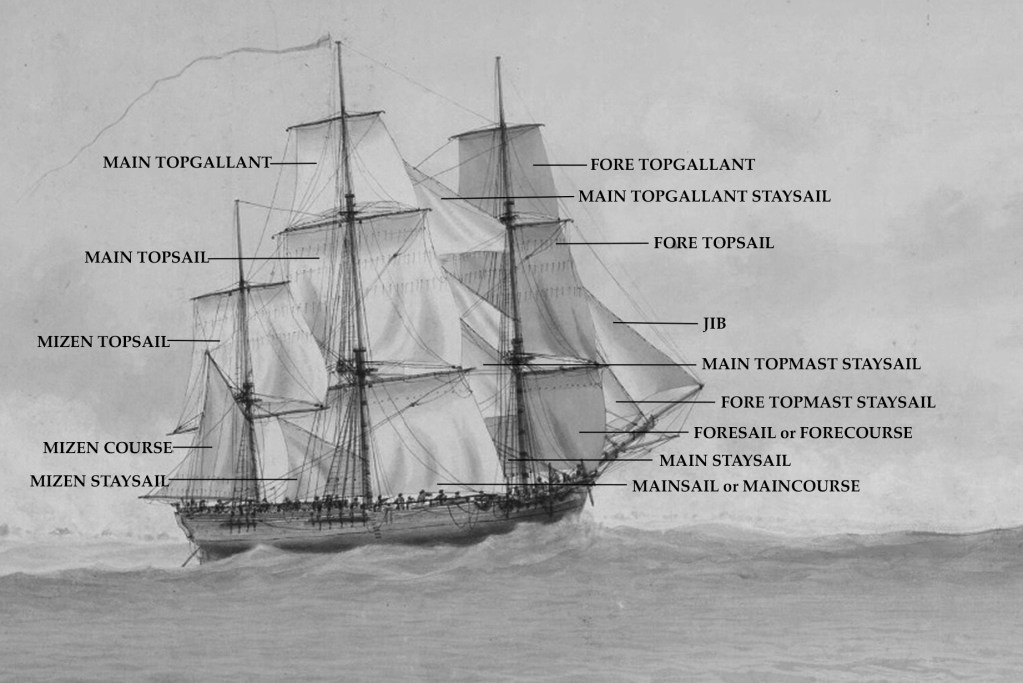
Courses – The lowest square sails on square-rigged masts [see illustration 1].
Court-martial – A court consisting of commissioned officers for the trial of members of the armed forces.
Crossing the Line – Crossing the Equator.
Dampier – William Dampier, (baptised 5 September 1651 died March 1715) was an English explorer, pirate, privateer, navigator, and naturalist who became the first Englishman to explore parts of what is today Western Australia.
Draw’d (also draft) – The depth of a ship’s keel below the waterline.
Dredge – An implement consisting of a net on a frame, used for gathering shellfish.
Dysentery – A general term for a group of gastrointestinal disorders characterized by inflammation of the intestines, particularly the colon. Characteristic features include abdominal pain and cramps, straining at stool (tenesmus), and frequent passage of watery diarrhea or stools containing blood and mucus.
Equator – An imaginary circle around the earth’s surface, equidistant from the poles, that divides the earth into the Northern Hemisphere and the Southern Hemisphere.
False Keel – A sacrificial length of timber fastened under the keel to take the wear caused by the vessel bottoming out or being hauled up a beach.
Fathom – A unit of length equal to 6 feet (1.8 m).
Flood – The incoming rising tide.
Flux – A flowing of fluid from the body, such as diarrhea.
Fore and aft – From the bow of a ship to the stern; lengthwise.
Forecastle – The upper deck of the ship forward of the foremast at the head of the vessel.
Fore foot -The lower part of the stem of a ship.
Fothering – Covering the leak in the ship with a sail containing rope fibres or other similar material to stop the leak. Tarred wool was substituted for rope fibres when the Endeavour was fothered after she got off Endeavour Reef.
Foul wind – A term for the wind when unfavourable to the ship’s course.
Four pounder – A cannon capable of firing an iron cannon ball weighing four pounds (1.8 kg).
Gig -A pronged spear for fishing.
Glasses – Telescopes.
Grapeshot -Small balls of lead fired from a cannon, analogous to shotgun shot but on a larger scale.
Great Cabin – A relatively spacious cabin at the rear of the Endeavour designed as a workroom for Cook and the Royal Society.
Gymp – A narrow flat braid or rounded cord of fabric used for trimming dresses, furniture, etc.
Haul the wind – To turn the head of the ship nearer to the point from which the wind blows.
Hawser – A small kind of cable.
Heaving her down – To turn the vessel on its side.
Helm -The ship’s steering mechanism.
Hoist -To raise or haul up.
Hold – The space between the lower deck and the bottom of the ship where her stores are held.
Hoops – Metal parts around the barrel that hold the staves together.
Hove – Heaved.
Keel – The main structural longitudinal member or backbone at the lowest point of the ship’s hull.
Larboard (port side)- An obsolete term for the left side of a ship, looking from the stern forward to the bow.
Lay to – To bring a vessel into the wind and hold her stationary. A vessel doing this is said to be laying to.
League – A unit of length used to measure distances, normally equal to three nautical miles.
Lee-shore -That shore upon which the wind blows.
Leeward – The direction toward which the wind is blowing.
Lieutenant – A commissioned officer who assumed command when the captain was absent. Lieutenants were responsible for standing watches, i.e. taking routine command of the deck when the ship was at sea with responsibility for maintaining discipline and navigation, and had overall command of a particular mast during setting and taking in sail. They would also oversee particular evolutions such as taking in stores or weighing anchor. An officer was required to have at least six years service at sea before passing the examination for promotion to Lieutenant and “appear” to be of the age of eighteen.
Log – A navigation tool consisting of a wooden board attached to a line (the log line) lowered into the sea. Used to estimate the speed of a vessel through water. The log line is wound on a reel so the user can easily pay it out and has a number of knots at uniform intervals. Counting the knots as the line pays out as the ship moves forward against an instrument for measuring time (sandglass) gives the ship’s speed.
Long boat – The largest of the Endeavour’s three boats, propelled by sails or oars, three masted and rowed by eight oars.
Luff – To point a sailing vessel closer to the wind.
Made sail -To set sail.
Main chains – The chain platform abreast the main mast.
Main yard -The lower yard on a mainmast.
Man at the lead – Also called a leadsman, who stands in the chains of the ship, up against the shrouds where he swings a lead plummet attached to a line of thin rope (lead line) to sound the depth of water.
Marine -A soldier trained for service afloat with many and varied duties including providing guard to ship’s officers should there be a mutiny aboard.
Masthead – A small platform partway up the mast, just above the height of the mast’s main yard. A lookout is stationed here, and men who are working on the main yard will embark from here.
Midshipman – This rank was usually filled by ‘young gentleman’ with aspirations to become a commissioned officer who joined from the age of nine onwards. They were responsible for overseeing tasks under the overall direction of a Lieutenant, such as going aloft to supervise sail handling or casting the log. They might be put in command of a ship’s boat.
Miss stays – A ship is said to miss stays, when her head will not fly up into the direction of the wind, in order to get her on the other tack.
Moor -To secure the vessel with a cable or anchor.
Morasses -An area of low-lying, soggy ground.
Musket – A muzzle-loading smoothbore flintlock long-barrelled weapon. The late 18th century British military issue musket was nicknamed the ‘Brown Bess’. It could be loaded with a lethal single lead ball, or with a less lethal charge of many smaller lead balls called “small shot”.
Oakum – Oakum was recycled from old tarry ropes and cordage used for packing the joints of timbers in wooden vessels.
Officer of the Watch – The officer responsible for the navigation of the ship, in the absence of the captain, during a certain watch.
Opiate – A substance derived from opium.
Pinnace – The second largest of the Endeavour’s three boats, propelled by sails or oars, double masted and rowed by six oars.
Poop – The rear deck of a ship is often called the afterdeck or poop deck.
Portable soup – A kind of dehydrated food of English origin used in the 18th century. It was a precursor of meat extract and bouillon cubes.
Privateer – A privately owned ship authorised by a national power to conduct hostilities against an enemy.
Punishment – Floggings were administered with a cat o’ nine tails. A total of 12 lashes per incident was most common, sometimes 24, with six as the least number. A total of twenty men are recorded as being punished on Endeavour. Stealing offences accounts for most. Other offences included disobedience, assault, desertion, leaving duty a shore, using abusive language to the officer of the watch, drunkenness, beating the sick and for refusing to eat their allowance of fresh meat. Some were punished more than once. Boatswain’s mate John Reading was punished for not doing his duty in correctly administering punishment to two others he was assigned to flog.
Purging – Vomiting.
Quadrant – An instrument for measuring the altitude of the Sun or a star above the horizon to find geographic position at sea.
Quarter deck – The aftermost or stern deck of a ship. During the Age of Sail, the quarterdeck was the preserve of the ship’s officers.
Quartermaster – Responsible for the steering of a ship.
Queirós – Pedro Fernandes de Queirós (1563 –1614) was a Portuguese navigator in the service of Spain, who in May 1606 reached the islands later called the New Hebrides and now known as the independent nation of Vanuatu. Queirós landed on a large island which he took to be part of the mythical “great south land,”, and named it Australia del Espíritu Santo – The Great South Land of The Holy Spirit.
Quires – A set of four sheets of parchment or paper folded so as to make eight leaves: the ordinary unit of construction for early manuscripts and books.
Reefing the sails – Reefing reduces the area of a sail, usually by folding or rolling one edge of the canvas in on itself and attaching the unused portion to a spar or a stay. Or by means of lengths of rope attached to the sail itself (at reef-points). This was the primary measure to preserve a sailing vessel’s stability in strong winds, or to slow the vessel.
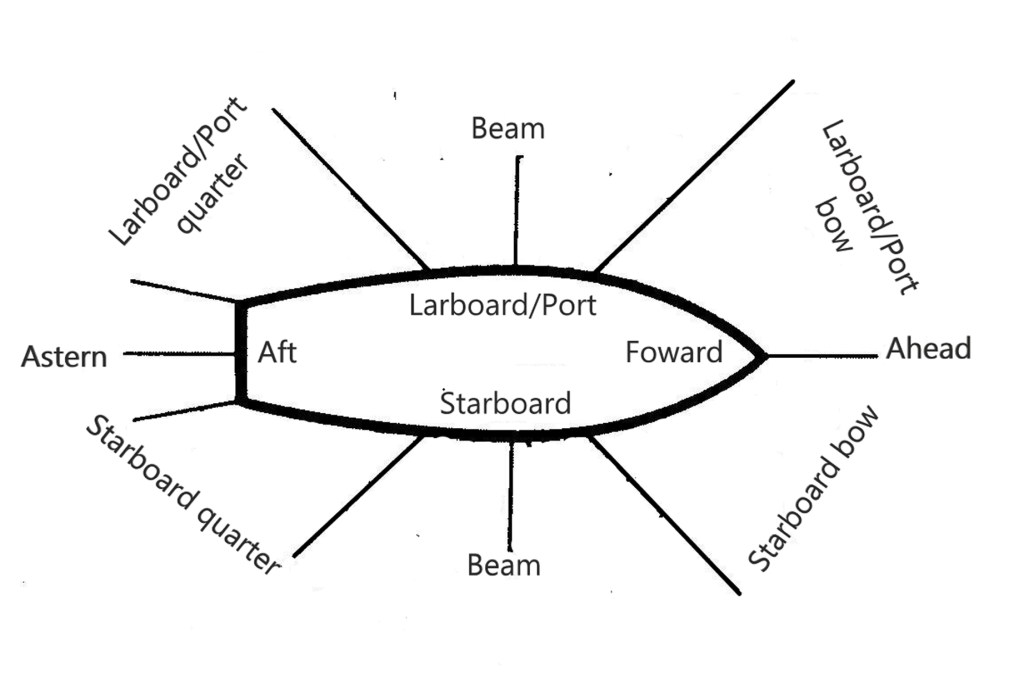
Relative bearings –
Roundshot -Cannonball.
Scurvy -A disease caused by deficiency of vitamin C, characterized by spongy and bleeding gums, bleeding under the skin, and extreme weakness.
Scurvy grass – Cochlearia is a genus of about 30 species of annual and perennial herbs in the family Brassicaceae. Most commonly found in coastal regions, on cliff-tops and salt marshes. Scurvy grass gets its name from the fact that sailors used to take it to prevent the disease.
Scuttle – Asmall hatchway or opening in the deck, with a lid for covering it.
Seine – A long fishing net that hangs vertically in the water, having floats at the upper edge and sinkers at the lower. It is used to enclose and catch fish when its ends are pulled together or are drawn ashore.
Sextant – A navigational instrument used to measure a ship’s latitude.
Sheathing board – A secondary layer of timber laid over the hull surface.
Ship’s time – The new day begins at noon.
Ships Master – The Master was the senior warrant rank and reported directly to the captain. Those classed as sea officers had equal status as commissioned officers and could stand on the quarterdeck. The master’s main duty was navigation, taking ship’s position daily and setting the sails as appropriate for the required course. He was responsible for ensuring the maintenance of the rope rigging and sails. Other duties included the stowing of the hold, inspecting provisions, taking in or moving stores so that the ship was not badly trimmed and reporting defects to the captain. He was also responsible for the security and issue of drink on board and supervised entry of parts of the official log such as weather, position, and expenditure.
Shoal – A stretch of shallow water, a sandbank, rocky area or coral reef, especially one that is visible at low water, but hidden at high water.
Shorten sail – To reduce sail by taking it in.
Shrouds – Heavy rope rigging giving lateral support to the masts.
Small shot – A less than lethal charge of many small lead balls fired from a musket, analogous to shotgun shot.
Sounding – Measuring the depth of the water.
Starboard – That side of a vessel which is on the right hand of a person who stands on board facing the bow.
Starboard Quarter – The starboard surface of the vessel’s hull that is located behind the beam (the widest part of the ship).
Stave – A narrow length of wood with a slightly bevelled edge to form the sides of barrels.
Stern Ports -Openings in the stern of the vessel for admitting light and air, fitted with strong shutters (deadlights).
Surgeon – The Surgeon was warranted to the ship by the Navy Board. They were the only medical officer on the ship and were assisted by Surgeon’s Mates (inferior warrant officers). They were responsible for the sick and injured, performing surgical operations as necessary and dispensing medicine. They were required to keep a journal of treatment and advise the captain on health matters.
Swivel gun – A small cannon, mounted on a swivelling stand or fork which allows a very wide arc of movement.
Tacking – A sailing manoeuvre for a vessel sailing into the wind by which it turns its bow toward and through the wind, thereby allowing progress in the desired direction. A series of tacking moves, effectively “zig-zagging” back and forth across the wind, is called beating, and allows the vessel to sail directly upwind, which would otherwise be impossible.
Tackle – A pair of blocks through which is rove a rope to provide an advantageous purchase. Used for lifting heavy loads and to raise and trim sails.
Taffrail – The handrail around the open deck area toward the stern of the ship.
The Northwest Passage – A sea route between the Atlantic and Pacific oceans through the Arctic Ocean.
The Royal Society – The Royal Society of London, originated in 1660 for improving Natural Knowledge, the oldest national scientific society in the world.
Thwart – A part of an undecked boat (or canoe) that provides structural rigidity for the hull. A thwart goes from one side of the hull to the other.
Topsails – The second sail (counting from the bottom) up a mast (see illustration 1 above).
Torrid zone -The region, between the Tropic of Cancer and the Tropic of Capricorn, characterised by a hot and humid climate; the tropics.
Touchwood – Rotten wood used to catch the fire struck from a flint.
Transit of Venus – Transit of Venus is a phenomenon in which the disk of the planet Venus passes like a small shadow across the face of the Sun.
Trim – To modify the angle of a vessel to the water by shifting cargo or ballast.
Tropic – The tropics are the regions of Earth surrounding the Equator. They are defined in latitude by the Tropic of Cancer in the Northern Hemisphere and the Tropic of Capricorn in the Southern Hemisphere.
Under an easy sail -To sail slowly.
Variation – A magnetic interference on the compass from magnetic fields, or from the vessel’s own equipment.
Victuals – Food fit for human consumption.
Viscera – The intestines.
Warp – To move a vessel by hauling on a line or cable that is fastened to an anchor.
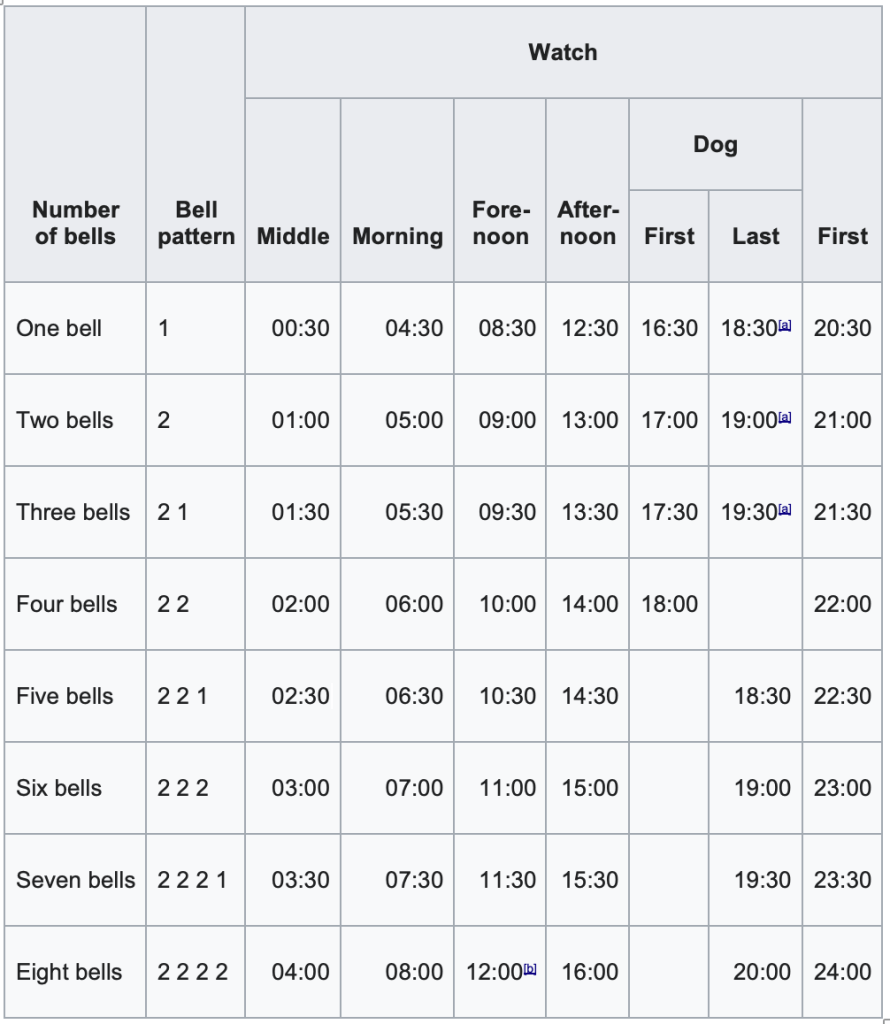
Watches and Bells – Most of the crew of a ship would be divided into two to four groups, called watches. Each watch would take its turn with the essential activities of manning the helm, navigating, trimming sails, and keeping a lookout. The hours between 16:00 and 20:00 are so arranged because that watch (the “dog watch”) was divided in two. The odd number of watches aimed to give each man a different watch each day; it also allowed the entire crew of a vessel to eat an evening meal, the normal time being at 17:00 with first dog watchmen eating at 18:00.
Waterspout – A funnel-shaped or tubular column of rotating cloud-filled wind usually extending from the underside of a cumulus or cumulonimbus cloud down to a cloud of spray torn up by the whirling winds from the surface of an ocean.
Weigh – To heave up an anchor preparatory to sailing.
Well – A place in the ship’s hold for pumps.
Windward -The direction that the wind is coming from.
Wore/wear ship – To turn away from the wind.
Yard -A horizontal spar from which a square sail is suspended.
Yawl – The smallest of Endeavour’s boats, propelled by sails or oars, single masted and rowed by four oars.